CBD and Cancer Quality of Life: What the Research Says About p53 Pathways and the Endocannabinoid System
I Am Going to Start With What This Article Is Not
This article is not a claim that CBD treats cancer. It is not a promise, a protocol, or a replacement for your oncologist. Anyone who tells you otherwise is not someone you should trust with your health.
What this article is: an honest examination of what published peer-reviewed research is showing about cannabinoids, the endocannabinoid system, and a tumor suppressor protein called p53. The research is real. The NIH has funded significant portions of it. It deserves to be discussed clearly, accurately, and without the inflated language that has damaged this industry for years.
I have spent forty years with this plant. I have watched people in pain reach for it when everything else failed. I have watched the research build from almost nothing to a body of evidence that serious scientists take seriously. I have also watched bad actors use that research to make promises the science does not support. That ends here.
What p53 Is and Why It Matters
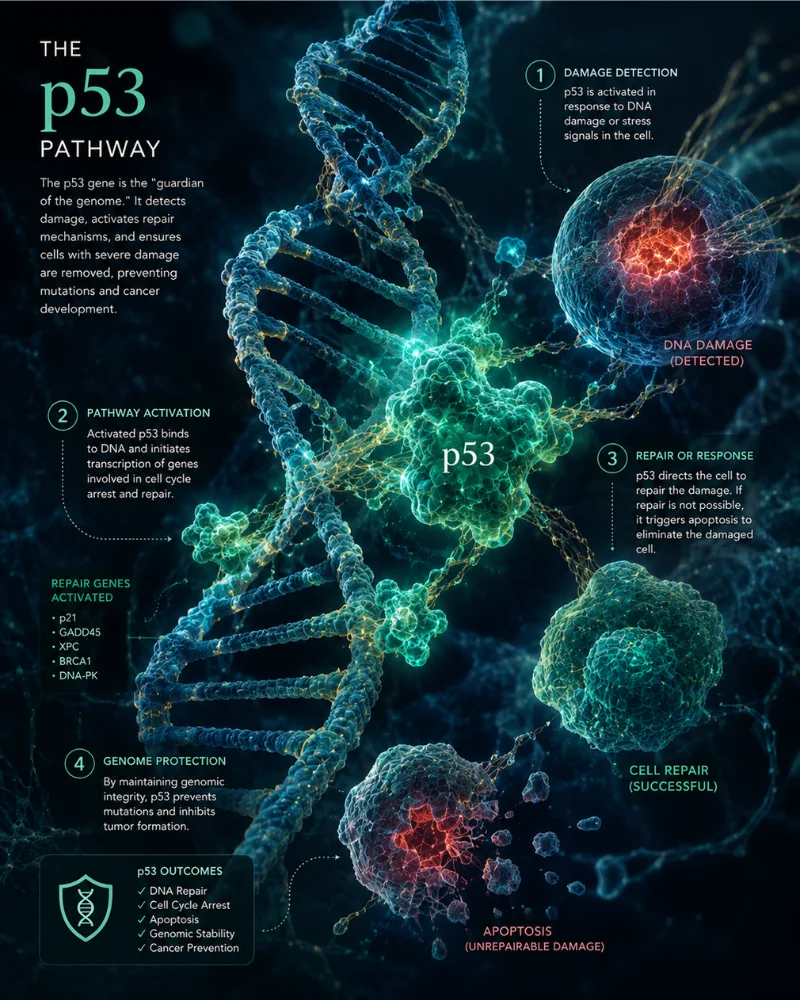
p53 is a protein encoded by the TP53 gene. It is one of the most studied molecules in cancer biology. Its primary job is to act as a tumor suppressor: detecting cellular damage, initiating DNA repair, regulating cell cycle progression, and triggering apoptosis, the programmed death of damaged cells, when repair is not possible.
When p53 is functioning properly, it is one of the body’s primary defenses against the uncontrolled cell growth that defines cancer. When TP53 is mutated or p53 expression is suppressed, that defense system is compromised. TP53 mutation is found in roughly half of all human cancers, making it the most commonly mutated gene in oncology.
Researchers studying cannabinoids have looked at how compounds from the cannabis plant interact with cellular pathways that regulate p53 expression and function. What they have found is not conclusive evidence of treatment efficacy. It is, however, meaningful enough to be published in the National Library of Medicine and funded by organizations that do not waste money on fringe science.
What the Research Has Found
A study published in the journal Oncotarget, cited in the National Library of Medicine, found that cannabinoids can influence p53-dependent apoptotic pathways in certain cancer cell models in laboratory conditions. The operative phrase is laboratory conditions. Cell culture and animal model findings do not automatically translate to human clinical outcomes. That is a distinction researchers make consistently and one that honest CBD companies should make consistently as well.
Research from the National Cancer Institute’s own database notes that cannabinoids have been studied for antiproliferative effects across multiple cancer types in preclinical settings. The NCI states that cannabinoids may have protective effects in some tumor models. The NCI also states explicitly that no clinical trials have established cannabinoids as an effective cancer treatment. Both statements are true and both belong in this conversation.
What the research does support more firmly is cannabinoid influence on quality of life markers in cancer patients. A 2019 review published in Frontiers in Pharmacology examined cannabinoid use in oncology settings and documented patient-reported improvements in pain management, nausea reduction, sleep quality, and anxiety levels. These are not cures. They are meaningful quality of life outcomes for people navigating one of the hardest experiences a human being can face.
The Endocannabinoid System and Cancer Biology
The ECS does not exist in isolation from cancer biology. CB1 and CB2 receptors have been found to be expressed, sometimes at elevated levels, in various tumor tissues. This is an area of active research. What it suggests is that the ECS may be involved in how the body regulates cellular behavior in disease states, not just in health.
Dr. Vincenzo Di Marzo, one of the leading researchers in endocannabinoid science and the discoverer of 2-AG, has written extensively about the ECS as a potential therapeutic target in oncology. His work does not claim that CBD cures cancer. It establishes that the endocannabinoid system plays roles in cell survival, proliferation, and apoptosis that warrant serious scientific investigation.
That investigation is ongoing. The science is building. And in the meantime, there are real people going through real cancer treatment who are using CBD for the things it demonstrably supports: sleep, pain, nausea, anxiety, and quality of daily life.
What Patients Are Actually Using CBD For During Cancer Care
When I talk to customers who are navigating cancer treatment, the conversation is almost never about a cure. It is about getting through the day.
Chemotherapy nausea is brutal. CBD does not replace antiemetics, but clinical research including a Cochrane Review examining cannabinoids for chemotherapy-induced nausea and vomiting found meaningful patient-reported benefit. The nausea conversation is one where the evidence base is among the strongest in cannabinoid medicine.
Cancer-related pain is often poorly managed by conventional protocols, particularly neuropathic pain. A 2010 study published in the Journal of Pain and Symptom Management found that cannabinoid therapy significantly reduced cancer pain in patients inadequately controlled by opioid therapy. The endocannabinoid system mediates pain signaling, and cannabinoid support for that system has real clinical backing.
Sleep disruption, anxiety, and loss of appetite are common and devastating quality of life impacts during cancer treatment. The ECS regulates all three. Supporting that system during the physical and emotional assault of cancer care is not a fringe idea. It is logical, compassionate, and backed by a growing body of research.
Why I Have Studied This Longer Than Most
My father died from cancer. That is the short version of a longer story that is woven into everything I have done since.
I made him a vow. I did not know exactly what form keeping it would take, but the direction was clear: get this plant to people. Not because I had proof of everything it could do. Because I had watched conventional medicine run out of road, and I had spent enough time with cannabis to believe it was capable of more than the world was being allowed to know.
That vow is why Banner Harvest exists. It is also why I have spent an obsessive amount of time in the cancer research literature specifically. Not as a scientist. As a person who lost someone and refused to stop looking for what might have helped, and what might help the people who come through our door carrying the same weight.
I am more studied on cannabinoids and cancer biology than most people selling CBD products. I say that not as a credential but as a fact that explains why I take this research seriously, why I read it carefully, and why I present it honestly without inflating what it shows. The people who trust us with this question deserve accuracy, not hope sold as certainty.
How to Have This Conversation With Your Doctor
I believe in transparency with your care team. If you are in cancer treatment and considering CBD, tell your oncologist. CBD is metabolized through the CYP450 enzyme system, which also processes many chemotherapy drugs. Potential interactions are real and your oncologist needs to know what you are taking to manage your care safely.
Most oncologists today are not hostile to the conversation. Many will tell you they do not have enough clinical data to make a formal recommendation. That is an honest answer. What they can help you assess is whether CBD is likely to interact with your specific treatment protocol.
The conversation is worth having. Your care is worth the effort of having it.
Why This Research Matters to Us
We do not make treatment claims because the science does not support treatment claims. What it does support is this: the endocannabinoid system is involved in fundamental cellular regulation. Cannabinoids interact with that system. Quality of life outcomes for cancer patients using cannabinoids are documented in serious peer-reviewed literature. Those are not small things.
The research will continue to build. We will continue to follow it honestly. And we will continue to make products worthy of the people who depend on them.
References: Velasco G et al. Towards the use of cannabinoids as antitumour agents. Nat Rev Cancer. 2012. | Massi P et al. Cannabidiol as potential anticancer drug. Br J Clin Pharmacol. 2013. | Portenoy RK et al. Nabiximols for opioid-treated cancer patients with poorly-controlled chronic pain. J Pain Symptom Manage. 2012. | Di Marzo V. New approaches and challenges to targeting the endocannabinoid system. Nat Rev Drug Discov. 2018.
FDA DISCLAIMER: These statements have not been evaluated by the Food and Drug Administration. This product is not intended to diagnose, treat, cure, or prevent any disease. This article is for educational purposes only and does not constitute medical advice.
Continue Reading
Is All CBD the Same?
From the outside, it all looks similar. Bottles, labels, hemp, natural, high potency. It blends together. But what is inside those bottles can be completely different. The difference starts at the source. How It Is Grown Matters Hemp is a phyto-remediator. That means it pulls compounds out of the soil — both beneficial nutrients and…What Is the Difference Between Hemp Oil and CBD Oil?
Hemp oil and CBD oil come from the same plant, but they are not the same product, and they do not do the same thing. And honestly, a lot of the confusion is intentional. Hemp Oil: What It Actually Is Hemp oil, more accurately called hemp seed oil, is made from the seeds of the…Why We Grow Our Own Hemp: Seed to Sale Story
Walk into most CBD stores, browse most CBD websites, and you will find brands built on impressive packaging, bold marketing claims, and very little else. Most CBD brands never touch a plant. They purchase finished oils or ready-made products from large commercial brokers, attach their label to the bottle, and sell it as though it…